History of the church
For a millennium and a half St Silin’s has been a place of worship, and although centuries have bestowed historical and cultural importance upon it, the church remains the spiritual heart of the Vale of Cynllaith.
There have been three churches on the present site. The first, probably built in the Age of the Saints by St Silin, would have been a small, wooden structure. Inevitably there are no traces of the original building but the magnificent yew trees in the churchyard are estimated to be at least a thousand years old and may date from the time of St Silin.
The first written record of a church is in the Red Book of St Asaph when in 1296 it was referred to as; Ecclesia Santi Egigii de Kynlleith. Llansilin was the clas, or mother church, of the Cynllaith valley and the original church was later replaced with a stone building, probably cruciform in shape. However, an archaeological examination in 2006 found no evidence of this. The existing stonework suggests there was a major rebuilding in the early years of the 13th century, but this was burnt down by Prince Henry, later Henry V, in 1403 in retaliation for Owain Glyndŵr’s rebellion.
In his history of the Diocese of St. Asaph, Archdeacon DR Thomas write; “according to the taxation of 1254 Llansilin formed part of the Deanery of Marchia, then in the Taxation of 1291 it was head of the Deanery of Cynllaith. In the valor (valuation) of 1535 it was again in Marchia, then in the subdivision of that Deanery in 1844 Llansilin was placed in the Deanery of Llangollen, but in 1881 it was transferred to Oswestry.
Church of Wales separation
When the Church of Wales was disestablished and separated from the Church of England, in 1920, most parishes in the Oswestry Deanery opted to join the Diocese of Lichfield, but Llansilin stayed in the Diocese of St.Asaph and was added to the Deanery of Llansilin in which it remains to this day. Uniquely, part of the parish is in England – the only part of England outside the jurisdiction of Canterbury. Services are held in both English and Welsh, this being one of the few districts on the English border where Welsh is still openly spoken.
Present building
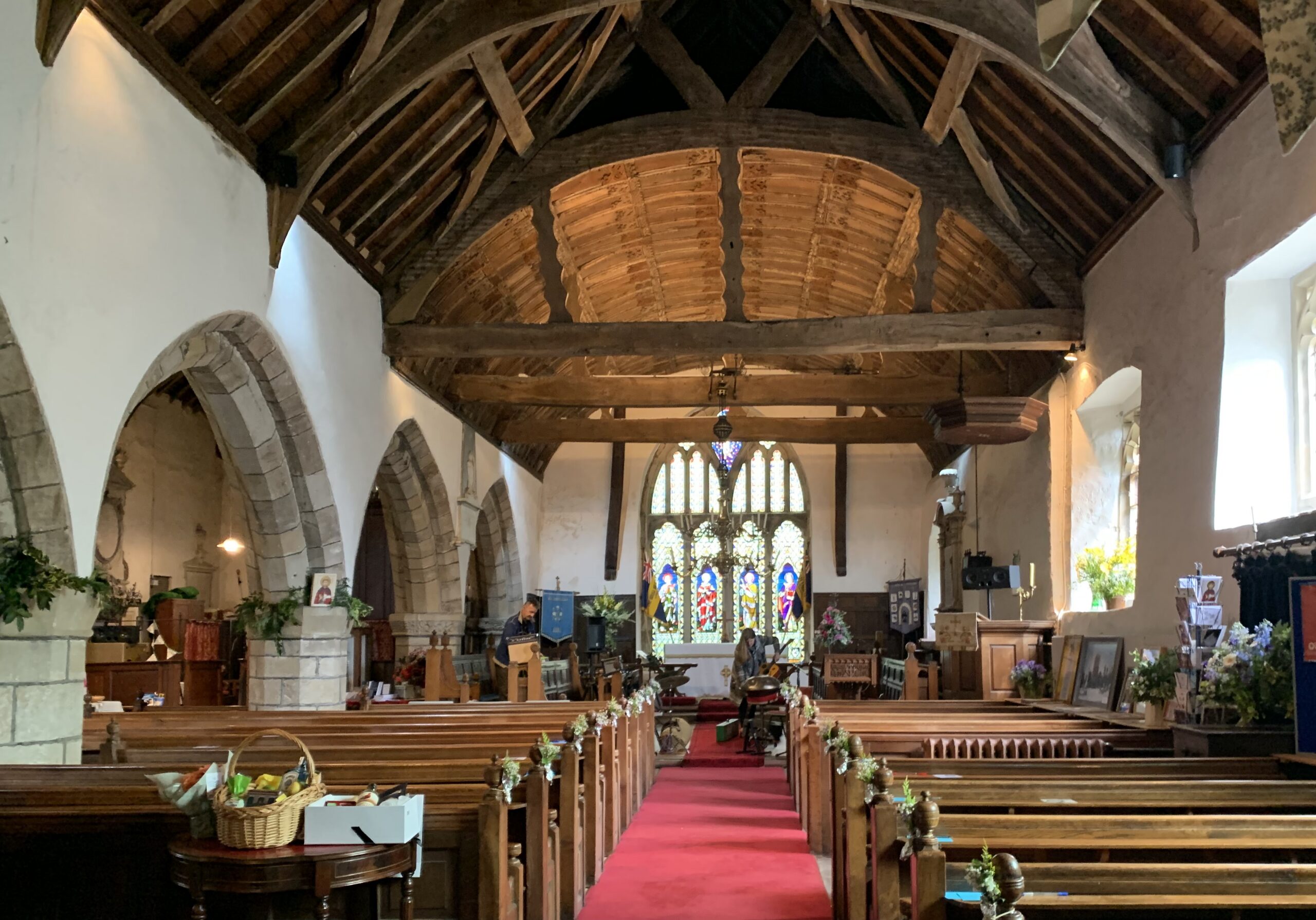
The present church was largely built in the 15th century, is rectangular and only covers part of the original site. The oldest remains to be seen in the present fabric belong to the beginning of the 13th century and are best seen in the carving of the capitals of the east and west pillars of the arcade, which is similar to that of the capitals in Valle Crucis Abbey, Llangollen. This suggests the church was being rebuilt at the time that Valle Crucis Abbey was erected. The Lord of Cynllaith, Einion Efell, was a first cousin of Prince Madoc, the founder of Valle Crucis, in 1199. Another relic of this period is the small lancet window in the south wall of the chancel.
The old pillars and capitals were used with the addition of three new pillars and enlarged north aisle, which was the original church and dedicated to St.Silin. However, the southern and wider part of the church, dedicated to St Mary was probably a lady chapel which, by several successive extensions eventually superseded the original church and now forms the nave and chancel.
Ieuan Bach, of Henblas, a house in the locality, started to build the east window in the chancel which was finished by his widow Gwenhwyfar and bore the names in painted glass. The glazing of the east window probably completed the rebuilding.
Civil War era
During the Civil War the kings army passed through Llansilin on it’s way to Chester, and the king retreated through the village after his defeat outside that city at Rowton Heath, but on the 23rd February 1646 the parliamentary force from Montgomeryshire took possession of the church and occupied it as one of a ring of strong points around besieged Chirk Castle. The bullet holes in the south door are believed to be surviving evidence of their occupation.
The parliamentary soldiers were able to carry out the order, given in 1641, to demolish and take away all images, altars, crucifixes and relives of idolatry, so the east window, erected by Ieuan Bach and his wife Gwenhwyfar, was destroyed. The parliamentary troops not only destroyed much of the church interior but, allegedly, used it as a stable for their horses.
Charles 1 to modern day
In the reign of Charles 1 the church was furnished with square pews and a pair of these “box pews” remains in the church today. It is possible that the wealthy inhabitants of the parish donated those pews, and the present pulpit with its sounding board.
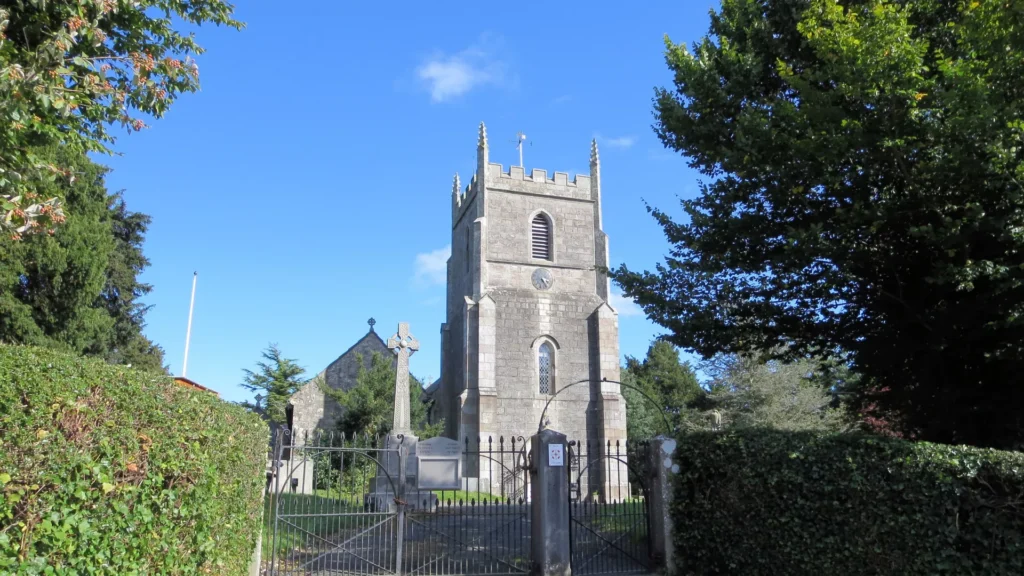
There used to be a wooden steeple, probably with three bells, but it was burnt down in 1813 and was replaced with the present tower in 1832.
A large porch was erected over the south door in 1771 and was probably used as a vestry, but was taken down in 1864. The iron gates used on this porch were part of a garden boundary in the village until they were returned to the church in 2003. They had cost £4. 3s. 3d. In 1817.
A second-hand organ was bought in 1859 and put into the musicians gallery, which must have been wider than it is at present.
During 1889-90 the church underwent a major restoration at the cost of £1,700. A list of subscribers shows that £1,700 3s. 4d. Was collected. The restoration was necessary because of the insecure state of the south wall, the condition of the roof and the very inconvenient arrangement of the seating. The ceiling was removed in the chancel and the 16th century carved roof was in view again. The box-pews were removed and the church re-seated with the present seats. Some of the carved wood was made into chancel seats. The gallery was made safe and the organ bought down and placed in St Silins chancel, and the present vestry was made.
The last sermon preached in the church before restoration was delivered on July 28th, 1889, by the ven. Archdeacon Thomas. It was reopened in June, 1890.
There were few major changes to the fabric of the church until electricity arrived in 1928. Power came from a hydro electric plant at the River Cynllaith which fed the village – but only just, and villagers always knew when a church service was about to take place. As the church lights were switched on those in the village dimmed.
During the Second World War the system failed altogether and the village and church returned to oil lamps until mains supply was installed in 1961.
Meanwhile, at some time, probably in the 1950’s the bells of St Silins had become silent and to be rung safely again required major restoration. This was accomplished as a millennium project and at the same time the number of bells was augmented from four to six. The work was completed in time to ring in the new century.
A second millennium project was the installation of floodlighting to enhance the beauty of the church at night.
As the church moved into the 21st Century it became clear that there was a serious need for a room where the church and community could meet and, on occasion, services could be held. An appeal was launched and substantial funding from grants was obtained with the remainder of the £150,000 coming from within the village and from well-wishers from near and far.
Building the room involved demolishing an old boiler house and producing plans that seamlessly harmonised with the original building, which is Grade 1 listed and therefore subject to stringent controls. A particular difficulty was finding stone which matched the original, and part of the new building incorporated stone from an outside privy in the village that was being knocked down.